Showing posts with label China residency. Show all posts

Sunday, 26 April 2015

MY PAINTINGS ARE INVISIBLE


MY PAINTINGS ARE INVISIBLE  is a poem for people who have gone missing. Made by Phil in Chongqing, China 2009-10, it was written onto a series of large semi-transparent sheets of paper and hung up on washing lines through the city, in parks, building sites, tea houses.

The poem posters are showing at Bury Sculpture Centre until 9 May, as part of the ReMix exhibition. If you can't get to Bury, the video gives a flavour.

Each poster is an 8-word verse, which remixes ancient Chinese poems with lines from contemporary text artists. Written onto large pieces of semi-transparent paper, one side scripted in English the other Chinese – they mingle calligraphies, meanings, histories. Principal artists involved as calligraphers and translators: Wang Jun, Mao Yanyang, Xu Guang Fu, Dan Dan, Deng Chuan and Yan Yan.

ReMix brings together artists from China and from the UK. The basis of their relationship is a curatorial exchange that has existed between Platform China, the artist run space in Beijing, and the British curator David Thorp. Alongside Philip Davenport, other UK based artists in the exhibition are David Blandy, A K Dolven and Richard Wilson.

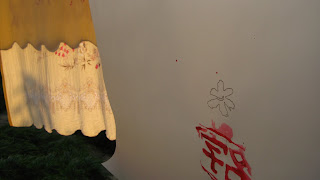
MY PAINTINGS ARE INVISIBLE poster on a washing line in Chongqing, 2009

Tuesday, 19 April 2011

yours mingles my dust


'Studio Chonqing' symposium will take place at Chinese Arts Centre, Manchester 21st April 2011 (details below). I've been invited to read from my work made in CQ, the poem 'My paintings are invisible' and some material from my journals. It seems a good moment to post my very last China journal entry.

January 2010

Snow glare from Beijing airport haloes the outsize buildings. We’ve wriggled one last time through the Beijing traffic – a wall of impossible complexity that made our taxi driver tut and play with his worry balls. An hour later, wrapped in warm aircon and easy pop, we’re combing the airport lounge for a decent coffee; an hour later again we’re rolling off the runway in the care of Finnair.

Screens are set into the headrests in front of us, we have the pilot’s POV for takeoff. I’m tired, dirty, stressed, stretched. Julia has grey sleep-lack around her eyes.

Now we’re climbing off the ground and below us on the runway we can see our shadow, caught in the screens, flit along the airstrip. Now we’re overhead and Julia is trying for some more photos through the plane window, cursing the overexposure. Now the screens are showing a 3D flightpath, Beijing below, Chengdu to our right, Xuanhua and Kalgan to the left.

The mountains are back again, the same mountains I saw on my arrival three months gone, and the snowplains outside the city. On the 3D computer graphic, our flightpath disappears with the world’s curve, to the other side of the globe. Our airspeed is 369, outside altitude 14491 feet as we bid goodbye to China.

“It’s minus 62 out there,” Julia says, the land all snow, the folds in contours like creases in a vast eiderdown, stuffed with white to the edge of our seeing. We slip into our own thoughts, then the shared dream of in-flight movies. I come awake with a jolt over Helsinki – wheels are spinning up dust in a car chase onscreen.


Studio Chongqing

A Live Collection of Work and Experiences from the 501 Residency, Chongqing, China.
Curated by Nina Chua and Jessica Longmore

Chinese Art Centre
21st April 2011
1-4pm

For free tickets and further information: http://chongqing-symposium-auto.eventbrite.com/

This event has been kindly sponsored by Arts Council England, Chinese Art Centre and Seabrook Associates.

Tuesday, 8 February 2011

Beijing Traffic


From China Journal January 2010

Is the idea of the self (itself) different in China? Maybe it's just that people are un/important in a different way. In the West, we make a great show of individuality, but the truth is that we dismiss the voices of older people, or the Roma, or the homeless, or the ordinary, or the suburban middle-agers, or the decried pram-face mums, or the ANYBODY. At best the Big Society rots down in the compost of a million blogs, like this one. Democratic people don't really have a swig of 15 minutes of glory, we are consecrated only by money and fame – the modcons of power.

Mao didn't bother fiddling around with subtle displacement activities. Such a liberal thing as an Individual was simply disallowed in his reign and in that of previous autocrats. So how does that affect people here? There are little enactments of difference scattered through my time in China and Beijing traffic is the latest.

The traffic in this city is, at first seeing, a hopeless chaos, a tangle of cars, trucks, bikes, pedestrians, police, all sharing too few lanes and in many cases the wrong side of the road. It's like a pile-up that still manages to keep moving. Pedestrians run at crossing points flocked together for safety, while cars jump the red and swerve through people gaps. Drivers hack bumper-to-bumper, leaning on horns and short-cutting outrageously, sliding between one another.

Is it because there's a kind of deep carelessness? Maybe on some level, people don't mind if either they, or others, are damaged. Are they depressed? I think of buildings in Chongqing being demolished by gangs of men with sledgehammers, hundreds of feet up in the air, smashing at the bricks under their feet that hold them aloft. They work with this level of danger because they've no choice; look in their faces, they're tired and desperate. But perhaps there are other reasons too, other ideas of what tots up human value.

Still the traffic comes, knifing thru the snow. Despite the melee, we see very few accidents. Along with the apparent self-harm element is a kind of beautific calm. Nobody displays anger. And on closer looking, there's a shared awareness of the whole traffic mass. Cars swift around one another, avoiding the bloody mind's-eye collisions that I see everywhere. Drivers honk, indicate profusely, shout, gesticulate – they are simply letting each other know 'I'm here' - driving is a negotiation between everyone, not a race of competitors. It's a subtle plot twist that sounds like bullshit but is in fact crucial to the outcome. So, driving in Beijing is today's metaphor. It looks and is messy but it's a group activity and road rage is impossible in the midst of this vehicle juggling, you'd be the first victim.

(When we get back to the UK, Julia will intone: “I'm driving Chinese,” if the going gets stressy and she wants to talk herself into relaxing.)

A bit of backstory from the late 1970s: the Misty Poets tried to fuse collectivism with a more western individuality. There was a short springtime and then the ubiquitous crackdown, regular as seasonal change. Which is where Beijing road rage actually makes its entrance, in tanks. Meantime, Julia and I watch the careening cars for a safe moment to cross the road and I wonder what our lives are worth on this big abacus.

Monday, 10 January 2011

Chi Chi the panda and the impossibility of freedom in the shared mind of any given social structure


(From China journal Jan 2010)

China as body politic has been a decade coming out of the big cold war freeze, but it's happening slowly and with contra-indications. On one hand there's an outbreak of Starbucks, on the other there's secret police fingerprints. In Chengdu we find the whole thing exemplified by pandas. Chengdu is one of the big international tourist stop-offs in China because this is, or was, panda country . (Less well-known is the beauty of Chengdu teahouses in summer; even less well-known is the fact that Yan Yan's mum lives here.)

On our first morning in the city, we book an early cab to see the pandas getting their breakfast. It's a cold, bright day with a little mist and we hurtle past dayglo shopfronts and little tableaux of huddled people readying stalls and gossiping, their breath condensing on the cold air. I feel properly a tourist today, snapshotting curiosities from our warm taxi. Julia is still acclimatising to the driving style and has her eyes closed.

We arrive in time for the first panda munch of bamboo shoots. The bears' audience of Chinese and European tourists coo as one. Pandas have the knack of appearing to pick delicately at their food, while in actuality shovelling hundredweights of breakfast down their throats. It's a dodge I envy. They are almost a definition of cute (aka “Q” here) with their Mary Quant eyes and cuddly demeanour and they've a delicacy at odds with their size. I flashback my dad's old cine footage of Chi Chi in the London Zoo of my early childhood.

The panda sanctuary is renowned for its inmates fabulous living conditions so we're disturbed to see the animals in small concrete cells, glassed on one side so that people like us can peer in at the bears despite their shyness. Then as we watch a magic trick occurs, a small steel door opens in the cell we are watching and the bear disappears into greenery. We go around the back to see a large field of grass, shrubs and trees where the bear is free to roam with a couple of companions. This pattern is repeated through the sanctuary. At first it's a relief to see the animals released into a bigger captivity. But of course it is still captivity. And it is one perhaps not so different to that shared by the human population.

Friday, 7 January 2011

No. 1 Emperor


(From China journal Jan 2010)

If you happen to find yourself in the walled city of old Xian you might think of visiting Lao Sun Jia. Climb some wooden steps between janglingly bright neoned shop fronts, part a polythene draught screen and you'll find yourself in a restaurant that's a venerable 100 years old. It looks like a Brit burger bar from the 1970s, all beige and formica, but the food is fit for picky kings. Julia and I stumble in, late evening, and within minutes the table is a mini-banquet of Yangrou Pao Mo, a lamb broth with bread crumbled into it, stir-fried pepper and beef, and - most spectacular of all - roast lamb and wolfberry. The sauce is a dark chocolatey sheen dotted with red flecks of the fruit. With our meal, come ale glasses of local tea. Within each glass are berries and flowers. It's like drinking the taste of a summer garden.

Xian sits on the Silk Road and part of this legacy is Muslim-influenced cookery. The city has a Muslim quarter near our hotel. The other legacy is the abiding principle of fear as a key to power. The city walls are 12 metres high, 14 km long and wide enough to accomodate a major road if you wanted to run one along it. A further outer wall, now gone, was seven times the length of this. Streets are a grid, typical for a military-friendly city - it's easier to crush rebellion.

Outside Xian, below ground level, is the city's most famous heirloom - the terracotta army. They are the death guardians of the First Emperor Qin Shi Huang, a man who both united and terrorised his subjects. He particularly liked burying people alive and it seems appropriate that those terracotta companions of his were not only buried, but are themselves made of clay. All returns to the earth, the lesson of Ozymandius. Although his army has been disinterred, the First Emperor's personal tomb has not been excavated. It is reputedly full of traps, mazes, underground rivers of mercury.

We walk around these hordes of clay people. The scale of the enterprise has a kind of wild triumphalism, as if Qin Shi Huang was going head-to-head with death. Or as a canny powerbroker, that's perhaps what he wanted people to think. It's a strange, dazing place - an archaeological dig the size of a battlefield roofed over aircraft hanger style. The army are in battle array, readied in columns. A few are separate from the main horde for close inspection, among them a ringer for Joe Stalin. I photograph some of them and text the picture to Trehy for his birthday message; he has a collector's fondness for autocrats.

Tuesday, 4 January 2011

Tibet Kitsch

(From China journal Jan 2010)

The Tibet Hotel in Chengdu has a marbled entrance foyer full of light effects and high-back cushioned chairs, doormen in brown felt coats and in the teashop a line of Tibetan wall embroideries. Up on the roof of this 20-odd-storey block is a Tibet-themed temple-style roof. There is Yak on the menu.

In our room are two crossbreed bhudda/pixies and the bathroom accessories in their spotlit cabinet are held in a silk bag with Tibetan-inspired calligraphy as decoration. It's funny in the way that corporate hotel themes are funny, but a joke with bad breath. In the last four years since the China-Tibet railway opened China has re-colonised this colony with train cargoes of migrant workers, aiming to dilute Tibetan-ness so much that the country becomes at last a province. The relationship, we are told, is an uneasy one. Our original plan was to visit Tibet but the extra travel and visas and money and the subzero season precluded the idea. With Julia still coughing from Huang Jie Ping's traffic smoke and studio chill I'm glad that this is the version we ended up with, however ersatz.

The room is toasting warm, the bath (my first in two months) has unlimited hot water, the bed has fresh linen, the thing is sumptuous. We sit in armchairs drinking the Oolong tea that Yan Yan gave us as one of his parting gifts. The tea is fabulous and the warmth of the room lulls us.

Yan Yan also gave me an exquisite writing book and green tea. Dan Dan gave Julia a red shawl for her cough and me a book of stone print characters. Deng Chuan gave me a pottery tiger that looks like an extra from Yellow Submarine. Yao Bo gave me Li Bai in Chinese, in answer to my Pound version. Wang Jun gave us a book of his work and a huge farewell feast. The reason I give this list is to make a point. None of these people are rich; all are generous with what they have and their consideration.

For my part, I elicited help from Deng Chuan in last-minute present buying rush and she made her disapproval for my thoughtlessness clear - and was additionally unimpressed when I try to make things better by spending more money. Present-buying is about the acknowledgement of the other individual; an inappropriate gift is sloppy and hurtful. So we drink Yan Yan's tea and I think about the kindness of China and the invasion of Tibet.

Tuesday, 28 December 2010

A green goodbye


The train to Chengdu is practically a jet plane. There are stewardesses in uniform and two cleaners who forlornly mop the shining floors throughout the journey. A security guard doubletakes when he sees Julia and I, fixing us in his mental inventory.

I'm writing this entry in hazy sunlight as we tumble mile upon mile through terraced fields. There are fir trees cresting the hills like green teardrops. Cupped in the valleys are rice paddies and low houses and crop stoops. There are ploughed hills and little scatters of villages and people working in the old ways, but my eyes have been starved of green in CQ so that's my predominant sense, that we are aswim in green. The land here is lush - we're going west, cutting across the vegetable gardens of China. It's late afternoon and Julia is trying to photograph the moon dancing along the telegraph poles.

An hour ago we said our goodbyes. Yan Yan, Deng Chuan and Wang Jun came to see us off. I felt sadness squeeze my ribcage as we parted. The two months in CQ have been guided by the care and kindness of these people, especially this trio - and they have become fast friends. The gatherings around art-making and hotpots have often been celebrations. I will miss this little gang with their sweetness and eccentricities. It's been awhile since Julia and I were part of a group and I've missed that social clustering. By cutting this link we also cut away from our shepherds through this land. We're out on our own now with a smattering of phrasebook Mandarin and a guessed itinerary. Julia has been awake half the night with a cold and I'm coming to earth after the rush of the teahouse exhibition. I wonder who's taking Ciao Q out for a walk this afternoon?

(Typing this up a year after it was written in my battered notebook, I'm happy to say that emails between myself and Wang Jun are a regular habit, with a visit forthcoming from he and Deng Chuan, that Yan Yan has sat in this house in Manchester with us for a meal and that Wang Jun snored his way from Yorkshire in the back of our car on one of our many expeditions during his Manchester residency early 2010, and that Ciao Q is still apparently wreaking havoc on his walks...)

Friday, 24 December 2010

Private view/punch up


Two students - Shu Jing and Yuan chao - have volunteered to help install the exhibition in Jiao Tong teahouse. At 10 am we meet in the studio, collect the long list of 12 or so pieces that I've selected from the original 50, plus string (always essential), pegs, nails, extension leads, lights, pencils. We set up camp on one of the trestle tables in the teahouse.

Hanging work is in itself one of the arts - to speak to the surrounds and yet have the works in dialogue with one another, to choreograph still space, to state simply, but keep ambiguity. My works spark alive when there is sunlight pouring through them and the world's colours. The teahouse is a dark space and the pieces look alright only in the windows and near light sources, which are dim. We set up some discreet lamps and peg the pieces into position so that they frame the fanatic card players but don't bug people.


Wang Jun's piece is an installation of overpainted magazines - it's a work that I've loved since he first took me round his studio and it' a pleasure to see it here, abutting onto the real. He lights the shelves he's used with bright fluorescents so that they glow like a shrine in a cliche. The mugs of the regulars here in the teahouse feature as part of the work, anchoring it in Jiao Tong.

Yao Bo meanwhile has placed pots on nine tables on the raised area in the middle of the space. Underneath each is a piece of off white paper with a black rectangle screenprinted onto it. From inside two of the pots can be heard her voice, reading aloud from her response to Beckett. The tiny electric voices crackle and whisper; people put their ears to the lips of the pots to hear. It's a show-stealer.

By 2 o'clock Wang Jun has installed his piece and lit it, Yao Bo is still tweaking her lights. Mine hang in the wondows opposite the entrance with card players sitting under them. One man loses his cash and holds his head in his hands. Julia snaps a portrait. Behind him, the poem says: Protect Me.

The guys who frequent the teashop stroll between the pieces and we chat it through. Someone offers to do some calligraphy for me - showing me the steadiness of his hands.

A journalist asks me why I bother putting my peculiar poems in places where no one will understand them. I take a deep breath at all the suppositions in that statement. I explain that if the work is placed among the world's bustle, it has the chance to be more alive than in the pages of a book. The room suddenly is unusually noisy. Yan Yan taps me on the shoulder: "For example, look over there. Real life."
There is a punch up taking place between two card players and people join the scrum. Yan Yan glances at me and grins: "It's real," he says again.

Private Views are posh showbiz and this one's no different. After the fighting has died away and the sore heads have been rubbed better, the art people arrive. The official opening is at 7pm, although the teahouse remains open all day for usual business. Julia and I are invited to join a long table of the local great and good, sipping flower tea. I end up swapping lines of poems with a DJ who wants to showboat her English and quotes lines of John Donne. In reply, I try her with a line from Tony Trehy. We struggle with the translation and she passes the line "Never to have compromised with transcendence" over to Yan Yan who shoots me a pained look.

Wednesday, 22 December 2010

Present for Xmas


Julia appears briefly at CQ arrivals gate, waves, gives a little skip and disappears again. 15 minutes and she reappears with her luggage, grinning sleepily. We hold hands as Yan Yan rockets us through the city and I point out the neons and mist. She's been held up by worldwide snow, made it onto one of the last two planes out of Manchester, got past delays in Helsinki (due to other less efficient airlines than Finnair) and Beijing (a mysterious medical emergency). 36 hours of travelling with no guarantee of arrival. Yan Yan drops us at the flat and we stroll Huang Jie Ping in the early hours, to let her descend from the adrenalin. She's my Xmas present.

Next day, I try to show off the studio and artworks to her, but Ciao Q effortlessly steals the moment by chewing open a tube of Yan Yan's oil paint and then licking it over his paws and around his muzzle. He doesn't like the taste, but loves the squeals of consternation when he chases people aropund the studio with the threat of blue paw marks. Yan Yan scolds; he hates it when Ciao Q's coat gets muddy and blue oilpaint is worse. My observation that Yan Yan's dog has the good taste to select a close match for International Klien Blue doesn't help. The favoured pronounciation of Ciao Q has changed once more to "Ciao Ko". I wearily start calling him "Ciao Ko" and the favoured pronounciation changes to Koko. Whatever he's called - not that he cares - his IKKB paws last two days.

Julia is wearing a vivid orange quilted coat that miraculously receives only one little blue smudge. Ciao Q likes her because she finds him funny. Later she takes him for an afternoon jaunt and he's won over entirely.

Later again she says to me - "You need to start thinking about how you light those pieces, they're dying in here when there's no daylight." She has a photographer's eye - unforgiving at times, but invaluable. She starts taking some experimental shots with her Leica, using the window in the hallway to frame people in the street outside.

The show is imminent and I haven't thought about light.

Tuesday, 14 December 2010

Stampos


Yan Yan casually suggests that I make some "stampos" for the poster poems.

“How?” I ask with a smallscale panic already building. These are the red identifying stamps that authenticate traditional Chinese artworks. They are complex little monograms, with many layers of meaning. Usually they are a reworking of the artist’s name in zhuan seal writing, or another archaic script, bonded together into a circular or rectangular design. They are dense, beautiful handcarved stamps (rather like our old fashioned seals) and require enormous skill to produce.

I've already introduced the idea into the poems - handstencilling red circles into the compositions and using them to add extra lines.

“Yao Bo will help, of course,” he shrugs as if to say: why don’t you think of these things Davenport? So Yao Bo is consulted and she agrees to oversee my attempts to model stamps in clay. I’m turning into a technician, but one without training or indeed much idea of what’s going on.
“OK,” I say, reluctantly.
“You will learn much about the Chinese way,” concludes Yan Yan, pleased at my impending betterment.

Yao Bo’s studio/apartment is next to Yan Yan’s in 501. She’s a petite woman, but suffused with energy, making ceramics, painting, writing – and she loves dancing. She swirls in and out of her connections with people in a pair of bright yellow boots. Her daily companion from upstairs is lonesome for her boyfriend and so she has breakfast with Yao Bo – lotus root and cigarettes – and hangs out.

The pair of them patiently shepherd me through the process of making a clay mould. Yao Bo shows me her own stamp and collapses with mirth when she hears that I’m trying to make one like it. We decide that I can try for something more like an official rubber stamp; that way I might be spared humiliation.

Jiao Tong - the last teahouse


Phil writes:

To coincide with the exhibition of my work at the Chinese Art Centre in Manchester, I've decided to post the last few entries of my China journal, written late 2009 - early 2010.


Jiao Tong – the last teahouse

The last traditional teahouse on Huang Jie Ping Street is closing soon, doesn’t fit here – it’s a goner. If you happen to be in the locale of the art school, take a left down HJP, walk 500 metres downhill, go through the mobile phone shop, drop down the little stairs and you are in an anytime. The walls have absorbed so much damp, so many knocks and so many years that they are crumpling with history.

There are continual games of cards, mah jong and chequers at the tables, slow games played out over long conversations. Two huge parrots swing on perches, cawing at the assembly. The tea is local CQ and comes with a big hot water thermos for refills, supplemented by a hot water lady with a long spouted pot like a steaming watering can.

Old men drink their brews and fresh-face art students sketch portraits of the clientele over and over so that they’ll be good enough to make it into the art college. In places, the students have pencilled faces on the walls too, perhaps they ran out of paper and in their fever just kept on drawing. This is the place I see Yan Yan look happiest – a student offers him a paper and pencil and for 10 minutes he draws, his concentration absolute, his face rapt.

Part of the side wall is open to the outside air and there are washing lines out back. The roof is like that of an old barn, with a long vent letting in even more air and daylight. There are discussions, disputes, deals being made. It was the social centre for the students 20 years ago, where they planned and dreamed. Hai Zi came here to drink the rough tannic CQ tea. I am told that Jiao Tong is important, famous. Sit here on the benches in this teahouse in Huang Jie Ping in China and you can feel that you are in all ages of the world, that anyone from any moment could walk in.

“This is my idea where we do exhibition,” says Yao Bo.

I feel a jolt of excitement.

Monday, 29 November 2010

Ghosts move about me patched with histories


Philip Davenport and Nicola Smith
Chinese Art Centre, Manchester, UK 9 - 17 December

Artists' Talk: 9 December 5.30- 6.30pm
Preview Evening: 9 December - 6.30pm - 8.30pm
Tour dates: 9 - 11 December


Ghosts move about me patched with histories is an immersive text/art experience, designed by poet Philip Davenport and performance artist Nicola Smith. Both have previously taken part in artist residencies in Chongqing and will use the exhibition to reflect on their time in China. The show counterpoints the freedom of being in a strange environment with the limits imposed by social control.

Davenport’s text installation is a poem written into wallpaper, covering one side of the gallery. Nicola will act as a deliberately misleading tour guide, taking visitors through the environment created by the pair, including a pause for snacks, some trashy TV and a computer that rewrites Davenport’s words with infinite variations, programmed by poet Tom Jenks. A live chicken will be ‘resident’ in the space.

The artist talk is free but booking is required: please follow the link below for tickets: http://whisper-residency-artists-talk.eventbrite.com/

The tours are free and running as part of the open studio as follows:

9 Dec - 7pm 10 Dec - 1.15pm and 3.30pm 11 Dec - 1.15pm


Special thanks to Tom Jenks and Leftfield, School of Art & Design, University of Salford www.salfordleftfield.co.uk for their help.

Supported by Arts Council England.

Davenport's China journal begins at http://arthur-and-martha.blogspot.com/2009/11/shared-loneliness-philip-davenport.html

Thursday, 28 January 2010

The invisible


Dec 18
Day 41

Deng Chuan and I make sorties with my ‘invisible paintings’, hanging them on clothes lines around Huang Jie Ping. The drying clothes frame them like metaphors for absence. Ciao Q comes along occasionally, but the chaos that inevitably accompanies him scuppers all attempts. He’s lately taken a fancy for the chickens that peck around the little campus gardens and when he’s not chasing them he picks dogfights. On our first afternoon we catch the best light and the fewest chickens.


Wednesday, 13 January 2010

The Yin Yang Logo

Sun Dec 13

Day 36

The Yin Yang Logo


Wang Jun is constructing a miniature city skyline on his studio floor. The buildings are made out of street bric-a-brac moulded into cylinders and bound together with a light concrete. Little pieces of plastic and electronic wiring are trapped in the concrete like fossils. Each unit is roughly the size of a corporate chain coffee cup, grande size. The heights vary from a couple of millimetres to 6 inches. He uses them to mark out an approx S-shape curve on the floor.


“S for Sheraton?” I suggest. “Starbucks?”

He looks at me wryly and starts to speak, Deng Chuan translating the gaps in his English and my Chinese: “It’s the yin yang. Very ancient, a shape for change. The piece is about change Fei Li Pu, about China changing. The line is buildings, maybe. Or could be a river. If you look at floor level, they could be a mountain range. It is a line drawn in 3D.”


Closeup, they are exquisite, the bright plastic fragments frozen amongst the grey. They are a sequence, but each one is an individual. “Like people,” says Wang Jun. “Or buildings, concrete and metal social units. But the materials of people’s lives are not industrial. The piece is gentle, small-scale - it is also very cruel, I think. Some people say the thing that hurts most is not a blow, but cruelty that is delivered gently.”


We sit on the floor among the tiny buildings. Yan Yan comes in. He thinks they should be bigger. I think they should be raised off the floor. Deng Chuan thinks they should be piled on top of one another.


Wang Jun shakes his head and talks to Deng Chuan who relays: “He says, they belong on the floor, it’s where the rubbish that made them comes from. After the exhibition, they will stop being art and they will be rubbish again. He says he wants his work to be gentle but within that it is cruel.”


Why cruel? But Wang Jun doesn’t answer directly. Deng Chuan says: “You know in China, balance is very important. Maybe this is something we can teach your culture. I don’t agree with the purely economic way and most Chinese don’t. But for a long time we have been poor, so new we grow up to be strong. We won’t be like Africa – we use the economy to arm ourselves. We have been poor and sick for 100 years and our people are afraid, they need to build confidence... But now the living standard is not so bad, I think that some people need to try living a different way, that is not just about money. Wang Jun feels this too, that’s why he uses the Yin Yang – we need some living one way and some living the other.”


What about the disastrous ecology summit at Copenhagen? “In China,” says Deng Chuan, “people care about their balance with nature, they have done for a long time. It is in our tradition. But they have been so poor and now they want to have a good life.”


“In China,” says Wang Jun, “They knock down poor people’s houses and put up buildings like this - ” and he nods at his little city on the floor. “They build on poor people’s lives.” We study it awhile. “A soft line to show hardness.”


The line begins and ends with the smallest pieces, broken fractions, so that it seems to grow up from the floor and sink back into it again. For me, it becomes an eye-metaphor for time – you don’t know if it’s coming toward you, or rushing away.


Wang Jun’s new work will premier at the Chinese Art Centre in Manchester as part of an exhibition which opens mid-January 2010.


Tuesday, 12 January 2010

The beautiful old buildings are sad


Sat 12 Dec

Day 33


Maybe this is the last industrial revolution, here in China before the earth gets to closing time for human business. There can’t be room to squeeze in many more and this place has some of the craziness of an end of season sale. The centre of CQ has been completely rebuilt and the rebuilding is being rebuilt it seems before the concrete is fully dry. They tell me that a CQ map (ditu) is out of date within 3 months, the city features so rapidly become unrecognisable. It’s a facelift being performed by a surgeon who is simultaneously having a facelift.


Riding into the epicentre, I carry the ache of my Friday massage with me. It’s as if I still have the man’s fingers in my shoulder muscles, clawing into me. But along with the pain has come mobility. The people on the metro into the city centre are for once not staring at me because of my skin colour, but because I’m behaving so oddly. For the whole journey into town, I exult in my new neck turning abilities, looking around behind me with the closest to 360-degree rotation that I’ve had in maybe 15 years, grinning happily at the passengers behind who look away in confusion.


While I write this over a drink, a young man who is time-killing in the café with his friends asks who I am. We have a brief spoken conversation and then resort to the computer, which converts my question into hanzi: what is China’s future? He taps into the machine and hits translate:

“China’s future is certainly more open, more harmonious and now many of the world incomplete knowledge of China who has been promoting China threat theory there are a lot of people’s understanding will remain in the era of last century, 40, 50. China’s future is definitely a very open beautiful and peaceful country.”

(Zhang Ming Jie, via computer translation)


It’s a diplomatic answer. I push him gently on it – ask isn’t it hard to lose all your familiar surroundings? He grimaces: “The beautiful old buildings are sad,” he tells me through the machine.

I talk him about my project and the homage to Hai Zi and he quotes a line from the famous Facing the Sea, with Spring Blossoms (《面朝大海,春暖花开》) – I write “I will hang my poem on washing lines, like clothes drying in the wind.”


On the metro back to Xie Jia Wan, the far bank of the Jialing River disappears into mist. The suspension bridge by Da Xi Gou station seems to deliver its evening traffic into an abyss lined with grey cotton wool. The closest twin is the London of old Sherlock Holmes films, all shadows and pea-soupers, with Basil Rathbone’s cheekbones the one sure guide. It’s tempting to conflate the two times and places, but that would be another layer of fog. The idea of an Industrial Revolution belongs to an era pre-Holmes. For the second time since the Cultural Revolution, China is ripping away the old skin – as if angry with itself. And the repayment for this loss comes in fast food outlets and designer brands in the town centre. Looking out at the river now, the only sharp visuals are neon signs.

Monday, 11 January 2010

Fri 4 Dec, Day 32


I’m writing this painfully, my shoulders feel beaten raw. The source of my pain is a little open fronted store on the Huang Jie Ping main road, which is staffed mainly by people with visual impairments. It is a massage parlour that Wang Jun goes to every week. This time he suggested I come along – the previous English artist at 501 had blissed out with the relaxing massages.

Ten minutes after arriving, I’m facedown on a massage table squirming with pain. The masseuse working me over is supposedly the best here. He certainly has a way of finding the least mobile parts of me, then grinding them together with enormous force. Wang Jun waves to me from the next bench and Deng Chuan who is behind me calls over: “He thinks your shoulder is a little sick.”

My right shoulder got damaged over a decade ago when I tried to chop down a sapling with an axe. I’ve never had much luck with axes, I get a bit crazed by them and start swinging around. I hit the sapling both hard and inexpertly and have spent many hours with physiotherapists since, regretting it and trying to patch the damage. My only consolation is that the tree is good and dead.

This massage isn’t like any I’ve come across before. I actually sweat with the pain of it. The masseuse checks with me, via Deng Chuan – am I OK? He knows that this hurts a lot but says that my shoulder muscles have stiffened so much he can hear them crack as he works into them. If I stick thru the pain I will feel better later.

I try reciting childhood poems to distract myself – Owl and the Pussycat, Lady of Shallot, Lake Isle of Innisfree, attempt to remember Bob Cobbing’s Alphabet of Fishes – but the pain volume dims out my words. I resort to counting in Chinese, then in English, then I simply endure it as best I can, crying out at the worst.

He works on me for 45 minutes or so, by which time I’m punchdrunk, dizzy with endomorphs. When he’s finished I tell him if I come again it’ll be in a suit of armour. I sit on a chair and shakily eat some of the local grapefruit (they come from Dan Dan’s hometown) dropping the pieces into a newspaper on my lap. Wang Jun is having his arm pulled vigorously and Deng Chuan has her face scrunched with discomfort.

But the star turn is a man at the back who has a vacuum suction jar placed onto his back – a big fold of skin and muscle is drawn up into the jar and the masseuse moves it rapidly back and forth across his back. The patient cries out over and over and the skin reddens as I watch. Another jar is added and another until there are maybe a dozen. Part-hidden under a sheet, he looks like a man who is morphing into a weird beast, a glass alligator perhaps.

I watch it numbly and eat my segments of grapefruit. I intended to work the rest of the day and into the evening but instead when we get back to wu ling yao I sit on a sofa in the studio and watch the walls tangoing round me as I crash from my body’s painkillers.

Thursday, 7 January 2010

Day 31 Thur Dec 3


This is part of an email I send to

my friend Carol Watts the poet:


Speaking of which I’ve been

sequestered here awhiles now away from my dayjob - struggling

to keep the head above water in a different way cos pretty much all I’ve done in the last month is exist

in the studio, making calligraphic work with various artists here - its alternately wonderful and stressful - I feel that I’m jumping into something big and complex and with an enormously misted surface.


“I’ve entered a language and signage that is simply and utterly not mine, but am trying to employ it to make a piece about human distance – I’ve used some people who are very naive writers as well as calling on experts so some of these works are going to be dismissed here because the adherence to calligraphic tradition is hugely ingrained and any deviation is seen to be simply coarse - then there’s the grand old habit of the West appropriating culture from here - eg. most of my deeper held reference to Chinese poetry is Pound's Cathay, which is itself an appropriation of a semitranslation - so I’m damned there too - but I note within myself alongside the nerves a certain glee at the prospect… cos the pieces are in a sense paintings, I’ve bound the idea of the thing together with dulux colours - and of course we none of us know if we're seeing the same colour.”


On the way back from the studio at 1am or so, I see an old lady the size of a small child, litter-picking to scrounge a living. She must be in her late 70s. Strapped onto her back is a basket far bigger than herself, filled with bits of cardboard and paper. She wobbles, looks as if she might sink under the weight. In that moment, I regret my flip comment to Carol about ‘keeping my head above water’. I mention it here to remind myself.

Wednesday, 6 January 2010

Killing a puppy

Days 29-30

Tues/Wed Dec 1-2


A puppy arrives on my doorstep, a skinny little thing, looks scared. It has hidden itself behind the large dressing table that my neighbour has dumped in the hallway along with his daily rubbish, cigarette ends and snack packets. I wonder if the dog is his too? It’s one of the toys – when I first saw it I thought it a rat. It has fouled the corridor several times and itself. When it sees me it bolts for cover under the dresser. I find the sight of the miserable little thing depressing. If I feed it, it’ll stay; if I leave it, who knows what’ll happen to it?


It howls once in the night, catches my eye in the morning and I sneak guiltily away to the studio. Give some money to a beggar instead, it’s emotionally cheaper.


Next evening the dog’s still there and the entrance to my apartment is a picknmix of litter and shit. In a fit of cruelty, I fill a bucket with hot water and detergent and sluice away the muck, leaving the puppy hidden under the dresser with a pool of water around it. It tentatively tries lapping at the hot stinking mess.


I shut my door on it, tell myself I can’t adopt a puppy and walk the anarchic Ciao Q. Cockroaches, rats, dirt and dogs are crowding me at the same time as my poem’s falling apart. My boundaries are dissolving and I cling to the poem like a left luggage ticket. I feel that I’ve not just left the UK, but am starting to float away from myself.


The puppy’s imploring eyes have freaked me. I fantasise about putting the dog in a box and dumping it in the streets so it’ll die quicker, out of my vicinity. If I wait til the early morning hours when I’m back from the studio, no one will be around and the thing can be easily done. I plan to dispose of it the following night. There are boxes stacked in the street after the night market finishes, just before the ragpickers scavenge the cardboard.


I want to talk to Yan Yan to check alternatives to murder, but he’s not around, tied in meetings. When I finally see him he’s worried-looking, overwrought with his job. He barely registers my presence then gives me the brush-off. I lose myself in work, solving nothing, sinking further into the mire.


Come midnight, I pack up. It’s raining and the night market is slush, boxes ruined. I ride the lift up to Jiu Lou (9th Floor) wondering if I can fit the dog into a plastic bag. But it has gone when I arrive and the sound of its howling comes from behind one of my neighbours’ doors. I sit on the edge of the bed and marvel at my own cracked brain: I am not like this.

Tuesday, 5 January 2010

Beetles

Day 28

Mon 30 Nov


Cockroaches upset me not because they are terrifying per se, in fact the babies are very pretty, like cartoons of themselves. In the UK they are a taboo, while in China as in many countries, they’re just a fact that’s less welcome than some, like ants or rodents or rain. But I remember struggling to keep a Council flat in Ardwick clean while roaches poured out of the wall partitions. They invaded the walls, the waste pipes, the cupboards, the fridge, the food. One night I forgot to check my salad before eating it and found myself with a wriggling mouthful. They carry a memory cargo to me in those little brown body cases.


“Meanwhile back, on Penny Lane…”


Meanwhile back in the studio, Deng Chuan likes The Beatles, Nick Cave, folk music, and syrupy Chinese ballads. Yan Yan votes for heartbreak Classical music, especially when delivered via piano. I’m free jazz, ancient crackling blues sung by people without teeth and rockandroll. Therefore when Yan Yan is away we crank up the stereo and go gothic or play The Beatles, as common ground.


I’ve picked up Revolver and the White Album, remastered for about a quarter of the UK price and Deng Chuan has Sgt Pepper. We put them onto Yan Yan’s fabulous machine. The energy blast of them jumpstarts us and we work late, laughing at the sheer happiness of the sound.


For the past godknowshowlong recording engineers have slaved on Beatle recordings, meticulously cleaning each Beatle-instrument, each Beatle-voice on the original tapes and then reassembling the mixes. It seems churlish not to listen, especially as I can bag up a couple of the gooduns for a fiver.


I played The Beatles to Beatle-death, time ago - they are as familiar as the hymns we used to sing at school assembly and memory patina is so deep that I don’t actually hear songs, I hear remembering. But the cleanup they’ve been given changes the texture of the whole thing - the joy in the recordings jumps and catches me unexpectedly. Sgt Pepper’s music bounces, while the White Album is heartbroken, the song Julia sweet and forlorn and crystal, as tho sung here and now.


Both Yan Yan and Deng Chuan get listless and deathly when I play atonal music - or sing, which amounts to the same thing as Trehy observed. Mostly we flit across Chopin and Schubert to Keith Jarrett and Alice Coltrane to Deng Chuan’s Chinese folk mixes. But in the evenings, working late it is to the dayglo of Deng Chuan’s Sgt Pepper, or the strange unravelling White Album, with its black holes and beauty.


(I get up from writing this in my apartment in Chongqing to make a drink and sure enough a baby roach disappears under the cooker.)


It seems to me that the biggest legacy of The Beatles is their pleasure at finding newness – of writing the future. That’s why I have such a problem with Fabnostalgia – it misses the alchemical fever that the music was made in. The John Lennon of 1966 would’ve gagged at the thought of a Beatle Experience museum.


So for me, the biggest wakeup comes just after a shot of Sgt Pepper, when Deng Chuan and Wang Jun find download after download of traditional Chinese folks, Siberian throat singers and eerie mountain music on the zithery gu qin. For them, this is history but for me it is as bright and new as those shiny remasters. We listen into the small hours, gathered around the little charcoal fire bowl, the lights of the laptops twinkling around us.